
Multi-Site Permit Compliance for Waste Operators | HardPan

Running one facility is a job. Running ten is a different job.
With a single site, you can keep the permit dates in your head. The renewal, the quarterly report, the annual inspection. You know them. Add a second facility, then a fifth, then a fifteenth, and that memory system quietly breaks. Not all at once. One missed date at a time.
The real issue here is not effort. Multi-site operators work hard. The issue is that the way most teams track compliance was built for one site and never rebuilt for many.
Here is what that looks like in practice, and a cleaner way to run it.
Why Multi-Site Is a Different Animal
More sites is not just more of the same. The work itself changes shape.
Each facility can carry a different mix of permits. A transfer station, a landfill, a construction-and-demolition operation, and a compost pad do not share the same obligations. Different renewal cycles. Different reporting forms. Different agencies, sometimes in different counties or states.
So you are not tracking one calendar. You are tracking a dozen calendars that do not line up, held by people who each see only their corner.
Which of your sites has something due next week? If you have to go ask around to answer that, you have already found the gap.
The Four Things That Slip
When a multi-site operator gets surprised by a compliance problem, it almost always traces back to one of four places.
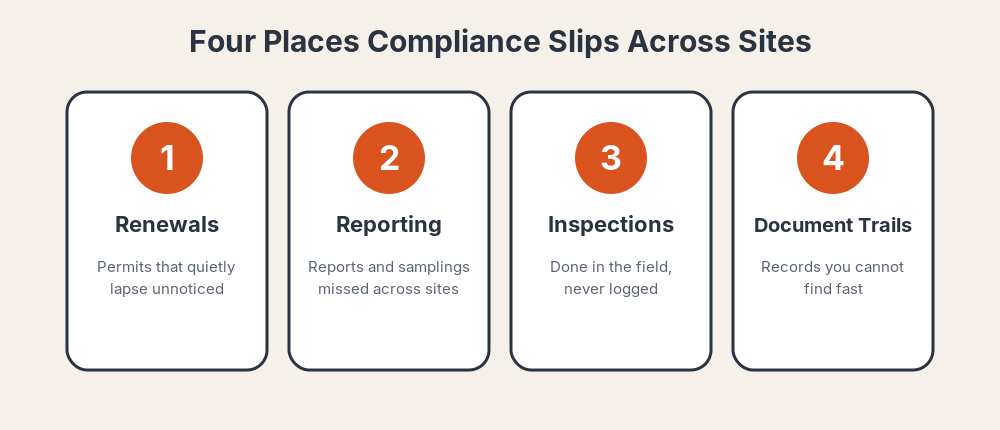
Renewals. A permit or registration lapses because the date lived in one person’s spreadsheet, and that person was out, or gone.
Reporting and monitoring deadlines. Quarterly and annual reports, sampling events, monitoring readings. Easy to do on time at one site. Easy to lose track of across many.
Inspections. Self-inspections that were supposed to happen weekly or monthly, done in the field but never logged, so no one can prove they happened.
Document trails. The report got filed and the inspection got done, but the record is sitting in someone’s inbox, or in a truck cab back at the site. When an inspector asks, you cannot find it fast.
None of these are hard tasks. They slip because no one has a single, current view of what is due, where, and who owns it.
What a Working System Looks Like
You do not need more software for its own sake. You need four things to be true at once.
One source of truth. Every permit, every renewal date, every recurring obligation lives in one place, not in scattered spreadsheets. If it is not in that one place, it does not exist.
Lead times, not just deadlines. Knowing a permit expires June 30 is not enough. You need the reminder weeks ahead, with enough runway to actually file. The date is the deadline. The lead time is what saves you.
One owner per site. Every facility has a name attached to it. Not “the office.” A person. Shared responsibility across many sites is how a task becomes nobody’s job.
One screen. Anyone who needs to can see, at a glance, what is current and what is behind, across the whole fleet. No calling around. No wondering.
Get those four right and most compliance surprises simply stop happening.
A Simple Way to Set It Up
You can build this in a week, not a quarter. Here is the order that works.
- List every site and every permit it holds. One row per obligation. Boring, and the most important step.
- Add the real dates. Renewal dates, report due dates, inspection cadence. For each, set a lead-time reminder, not just the deadline.
- Assign an owner to every site. One name per facility, responsible for its list.
- Put it on one screen everyone trusts. A dashboard, a shared board, whatever your team will actually open.
- Review it on a set day. Same day each week. Work the overdue items first, then what is due soon.
That is the whole system. The value is not complexity. It is that nothing lives in someone’s head anymore. The tool matters less than the habit, and the habit is the part people underestimate.
Where Operators Trip Up
A few honest failure modes, so you can watch for them.
Spreadsheets that only one person maintains. The moment they are unavailable, the fleet is flying blind.
Tasks done but not logged. The inspection happened. The proof did not. To an auditor, undocumented and undone look the same.
Treating every site as one. Bulk reminders that ignore which facility needs what create noise, and noise gets ignored.
Each of these is fixable, and none of them require a big budget. They require one current list and the discipline to work it.
The Payoff
When every permit, date, and owner lives in one place, the week before an audit stops being a scramble. You already know what is current. You can produce the record when asked. Nothing is riding on one person’s memory.
That is what “on track” actually means across many sites. Not perfection. No system gives you that. A system that tells you the truth before a deadline does.
Start with one clean list. This part is fixable.
If you would rather not build it yourself, one screen for every permit and every site is what HardPan does. Book a Demo when you want to see it.
Related Guides
- How Your Compliance Band Works: reading fleet-wide compliance at a glance
- Filling Out a Permit Record: the dates that drive your renewal reminders
- How Reminders and Notifications Work: lead-time alerts so nothing lapses