
Ohio Waste Facility Permits, Decoded | HardPan
If you run waste sites in Ohio, the paperwork does not come from one place. Ohio waste facility permits pull from the state, from your county, and sometimes from city hall, and each one keeps its own calendar.
Run one site and you can hold it in your head. Run eight across three counties and the map goes blurry. Which agency issued what. Who renews it. When.
Here is the map, in plain terms. What each permit covers, who hands it to you, and the dates that bite if you miss them. Current as of July 2026.
The Two-Step Behind Almost Every Ohio Facility
Most disposal and transfer facilities in Ohio clear two gates, not one.
First, the Permit to Install (PTI). This comes from Ohio EPA’s Division of Materials and Waste Management. It is the state signing off that your facility is sited, designed, and built to the rules before you open or expand. New facility, or a real modification, and you file the PTI application well ahead. For a new solid waste facility, that is at least 270 days before you plan to operate (ORC 3734).
Second, the operating license. This one is annual, and it usually comes from your county, not the state. Ohio delegates licensing to approved health districts, meaning the local board of health. If your district is not on the approved list, Ohio EPA issues the license instead. Same license, different desk.
So the PTI is one-time, until you modify. The license is every year. Get those two straight and most of the Ohio picture clicks into place.
The Main Authorizations, Decoded
Different facilities carry different obligations. Here is what each of the common ones actually is.
Sanitary landfill. The heaviest lift. PTI from Ohio EPA, annual license from the health district, groundwater monitoring, financial assurance, and disposal-fee reporting. The design and operating rules have long sat in OAC 3745-27, which is now being renumbered (more on that below).
Construction and demolition debris (C&DD) facility. Its own statute, ORC 3714, and its own rules in OAC 3745-400. Licensed by the approved health district. Before your first license, you post financial assurance of at least $13,000 per acre of disposal area.
Transfer facility. Where waste is consolidated before it moves on. PTI plus annual license, same structure as a landfill, lighter engineering.
Composting facility. Sorted into classes under OAC 3745-560. A Class I facility needs a Permit to Install from Ohio EPA. Class II, III, and IV facilities register instead and post financial assurance. Your class depends on what you take in and how much.
Scrap tire facility. Storage, monofill, monocell, and recovery each carry their own rules. A scrap tire disposal facility needs a PTI and a license. A large storage site, over 10,000 square feet, is permitted; a small one is registered. Transporters carry an annual registration on top.
Infectious waste treatment facility. Licensed by the health district or Ohio EPA, under the same ORC 3734 framework.
Hold a mix of these across sites and you are not tracking one obligation. You are tracking six kinds, each on its own clock.
Who Hands You What
Three desks, and operators mix them up all the time.
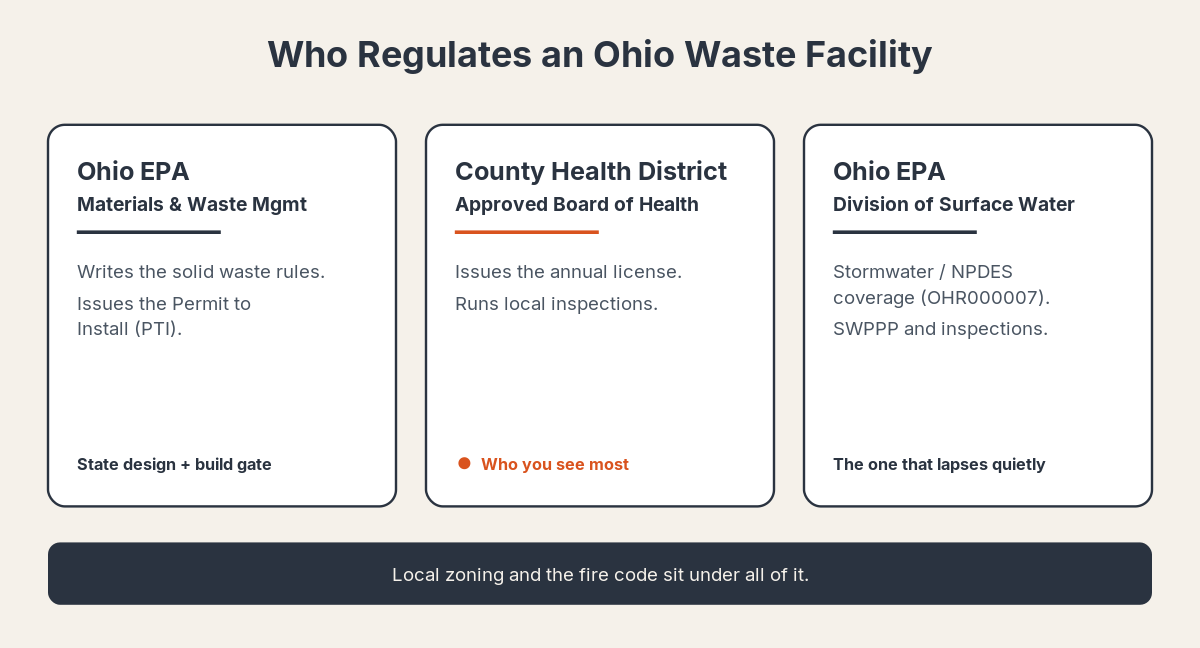
Ohio EPA, Division of Materials and Waste Management. Writes the solid waste rules and issues Permits to Install. This is the state design-and-build gate.
Your approved county health district. Issues the annual operating license and does the routine local inspections. This is who you see most. Because it is delegated, the forms and the people differ county to county, which matters the moment you cross a county line with a second site.
Ohio EPA, Division of Surface Water. Handles the stormwater side, the NPDES permits. Different division, different rules, easy to forget until it is late.
Could you say, right now, which of those three issued each permit you hold? For one site, easy. Across a fleet, that is the thing that slips.
Local zoning and the fire code sit underneath all of it. Not the focus here, but real.
The Stormwater Piece Everyone Underestimates
If your site has industrial activity out in the weather, and most waste sites do, you likely need coverage under Ohio’s industrial stormwater general permit, OHR000007. Landfills fall in Sector L of that permit.
Coverage is not file-and-forget. You submit a Notice of Intent, you keep a Stormwater Pollution Prevention Plan (SWPPP) current on site, and you run the routine visual checks and the annual site-compliance evaluation the permit calls for.
OHR000007 took effect June 1, 2022 and runs five years, so it expires May 31, 2027. When Ohio EPA reissues it, every covered site has to re-up coverage under the new permit. Put that on next year’s calendar now.
The Dates That Bite
The obligations are not the hard part. The timing is where multi-site operators get caught.
| Permit or Report | Frequency / Deadline | Issued or Filed With |
|---|---|---|
| Permit to Install (new or modified facility) | File at least 270 days before operating | Ohio EPA, Materials and Waste Management |
| Annual operating license application | By September 30 of the prior year; +10% fee per week late | Approved county health district |
| Operating license | Expires December 31; renew every year | Health district (or Ohio EPA) |
| Industrial stormwater coverage (OHR000007) | Keep NOI and SWPPP current; renew when reissued (expires May 31, 2027) | Ohio EPA, Division of Surface Water |
| Stormwater inspections | Routine visual checks plus an annual site-compliance evaluation | Facility, logged on site |
| Landfill operational report and disposal fees | Annually, on the state schedule | Ohio EPA / health district |
Fee amounts and a few of the report dates shift by facility type, so treat the specifics here as a starting point and confirm your own. The structure holds; the exact numbers are worth checking.
That September 30 date is the quiet one. It lands before the year you are licensing even begins, so it is easy to treat December 31 as the deadline and miss the real one by three months.
Where Multi-Site Ohio Operators Trip Up
A few honest failure modes, so you can watch for them.
Assuming every county works the same. Licensing is delegated, so two sites in two counties can face different forms, different inspectors, and different expectations. What sailed through in one county gets questions in the next.
Old rule numbers that have moved. Ohio is renumbering its solid waste rules. The old OAC 3745-27 is being broken into a new 3745-500 series. Composting already lives in 3745-560, and the licensing and permit procedures in the 3745-500 rules. If your SOP cites a 3745-27 rule from a few years back, confirm it still exists before you lean on it.
Stormwater treated as one and done. It is the permit most likely to lapse quietly, because nobody mails you a renewal notice the way they do for the license.
The 270-day runway, forgotten. Deciding in spring to open a new cell or facility by year-end does not work in Ohio. The PTI clock alone is nine months.
None of these need a big budget. They need one current list of every site, every permit, and every date, with one person who owns it.
Staying Ahead
The Ohio picture is not complicated once it is written down. A two-step per facility, a September 30 license deadline, a stormwater plan that has to stay live, and a rulebook in the middle of renumbering. The trouble only starts when those live in different heads across different sites.
Put them in one place. One row per permit, per site, with the real date and a lead-time reminder ahead of it. Then September 30 and the 270-day runway stop being surprises.
For the fuller playbook on running this across a fleet, start with How Multi-Site Waste Operators Keep Every Permit on Track: the same one-screen approach, applied to any state.
Start with one clean list. This part is fixable.
Related Guides
- Filling Out a Permit Record: the dates that drive your renewal reminders
- How Reminders and Notifications Work: lead-time alerts so a September 30 or a 270-day runway never sneaks up
- How the Self-Inspection Schedule Works: logging stormwater and site checks so they are provable